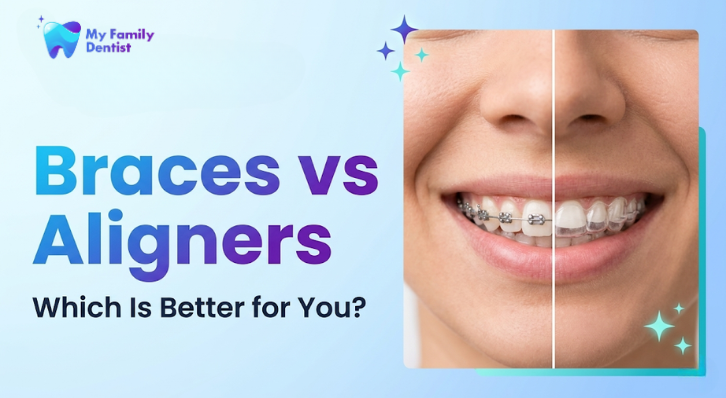
When choosing a teeth straightening treatment, many patients compare braces vs aligners to find the best option for their needs. Both treatments are effective, but they differ in appearance, comfort, cost, and suitability for different dental conditions.
Understanding the difference between braces and aligners can help you make an informed decision based on your lifestyle and dental requirements.
Overview of Braces and Aligners
Orthodontic treatments are designed to correct:
- Crooked teeth
- Gaps between teeth
- Bite problems (overbite, underbite)
- Crowding
The two most common options are:
Braces
Fixed orthodontic appliances that use brackets and wires to gradually move teeth into position.
Aligners
Removable, clear trays that apply controlled pressure to shift teeth over time.
How Braces Work
Braces consist of:
- Metal or ceramic brackets attached to teeth
- Archwires connecting the brackets
- Elastic bands (in some cases)
The orthodontist adjusts the wires periodically to guide teeth movement.
Key Points
- Continuous force is applied
- Works effectively for simple to complex cases
- Does not rely on patient compliance
How Aligners Work
Clear aligners are custom-made trays created using digital dental scans.
Patients wear a series of aligners, each slightly adjusted to move teeth gradually.
Key Points
- Worn for 20–22 hours per day
- Removable for eating and brushing
- Replaced every 1–2 weeks
Key Differences Between Braces and Aligners
| Feature | Braces | Aligners |
|---|---|---|
| Visibility | Visible | Nearly invisible |
| Removability | Fixed | Removable |
| Comfort | May cause irritation | Generally more comfortable |
| Maintenance | Requires careful cleaning | Easier oral hygiene |
| Discipline | Low | High (must wear consistently) |
| Suitability | All cases | Mild to moderate cases |
Pros and Cons of Braces
Advantages
- Effective for severe misalignment
- Predictable results
- Suitable for all age groups
- No reliance on patient compliance
Limitations
- Visible appearance
- Dietary restrictions
- Difficulty cleaning around brackets
- Possible discomfort after adjustments
Pros and Cons of Aligners
Advantages
- Nearly invisible appearance
- Removable for eating and brushing
- More comfortable edges
- Fewer dietary restrictions
Limitations
- Requires strict discipline
- May not be suitable for complex cases
- Can be misplaced or damaged
- Needs regular monitoring
Which Option Is Right for Different Dental Conditions?
Choosing between braces and aligners depends on the severity of the dental issue.
Braces May Be Recommended For:
- Severe crowding
- Complex bite problems
- Rotated or impacted teeth
- Cases requiring precise control
Aligners May Be Suitable For:
- Mild to moderate misalignment
- Spacing issues
- Minor bite corrections
- Patients seeking aesthetic treatment
An orthodontist evaluates clinical condition, jaw alignment, and treatment goals before recommending the appropriate option.
Cost, Comfort, and Maintenance Comparison
Cost
- Braces are often more affordable
- Aligners may cost more due to digital technology
Comfort
- Aligners are generally more comfortable
- Braces may cause irritation initially
Maintenance
- Aligners allow easier brushing and flossing
- Braces require more effort to maintain oral hygiene
Effectiveness and Treatment Time
Both treatments are effective when used appropriately.
Treatment Duration
- Braces: 12–24 months (varies by case)
- Aligners: 6–18 months (for suitable cases)
Important Consideration
Aligners require consistent wear. Irregular use may delay results.
Braces provide continuous force, making them more reliable in complex cases.
Safety Considerations and Limitations
Braces
- Risk of plaque buildup if hygiene is poor
- Possible gum irritation
- Requires regular orthodontic visits
Aligners
- Risk of delayed results if not worn properly
- Requires good patient compliance
- Not ideal for all dental conditions
Both treatments are considered safe when monitored by a qualified orthodontist.
When to Consult an Orthodontist
If you are unsure whether to choose braces or aligners, a professional evaluation can help determine the best option.
An orthodontist may assess:
- Teeth alignment
- Jaw relationship
- Bite issues
- Oral health condition