Losing a tooth can affect much more than your smile. It may make chewing difficult, alter speech, shift surrounding teeth, and gradually lead to jawbone loss if left untreated. Fortunately, modern restorative dentistry offers reliable tooth replacement options, with dental implants vs bridges being the two most commonly recommended treatments.
If you’re comparing dental implant vs bridge options and wondering which provides better long-term value, comfort, and appearance, the answer depends on several factors—including your oral health, bone condition, budget, and personal preferences. While dental implants are often considered the most durable solution, dental bridges remain an effective option for many patients.
This comprehensive guide explains the differences between dental implants vs bridges, their advantages, limitations, longevity, maintenance requirements, and situations where one treatment may be more suitable than the other. If you’re looking for the best missing tooth solution in Bhubaneswar, understanding these differences can help you have a more informed discussion with your dentist.
Why Replacing a Missing Tooth Is Important
Many people postpone replacing a missing tooth, especially if it is not visible while smiling. However, leaving a gap untreated can affect your oral health over time.
A missing tooth can lead to:
- Difficulty chewing certain foods comfortably
- Increased stress on neighboring teeth
- Teeth gradually shifting into the empty space
- Changes in bite alignment
- Jawbone shrinkage after tooth extraction
- Changes in facial appearance over time
- Greater risk of gum problems around surrounding teeth
Replacing a missing tooth helps restore both function and aesthetics while supporting long-term oral health. Whether through a dental implant or a bridge, timely treatment can reduce future complications and improve overall quality of life.
What Are Dental Implants?
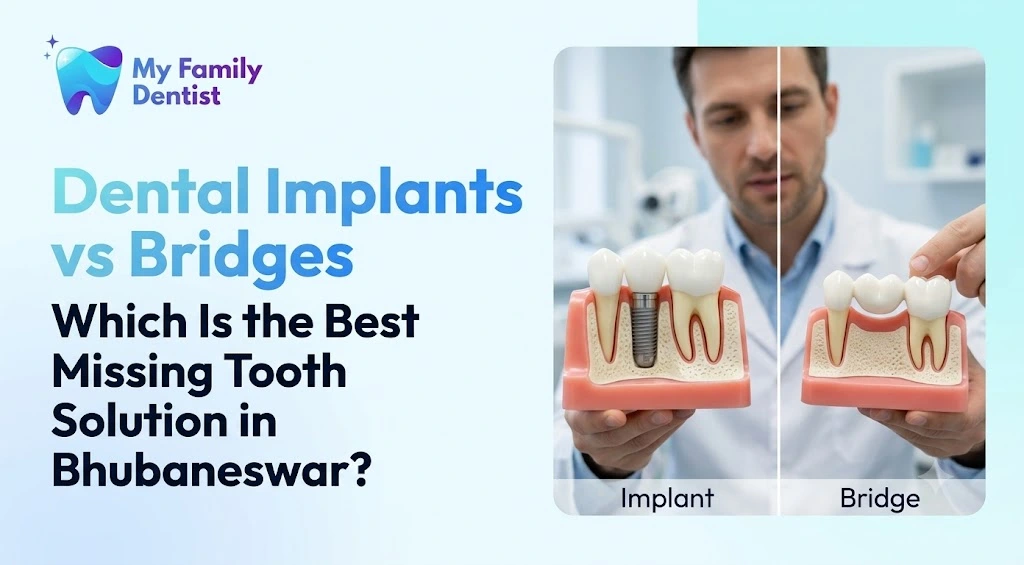
A dental implant is an artificial tooth root, typically made of biocompatible titanium, that is surgically placed into the jawbone. After the implant integrates with the bone through a natural healing process called osseointegration, a custom-made dental crown is attached to restore the appearance and function of the missing tooth.
Unlike traditional restorations, implants replace both the root and the visible portion of the tooth, closely mimicking natural tooth structure.
How Dental Implants Work
The implant treatment process generally includes:
- Comprehensive dental examination and digital imaging
- Assessment of jawbone health and gum condition
- Placement of the dental implant into the jawbone
- Healing period to allow bone integration
- Placement of an abutment
- Attachment of a custom-made dental crown
The total treatment timeline varies depending on healing and whether additional procedures, such as bone grafting, are required.
Advantages of Dental Implants
Dental implants offer several long-term benefits:
- Replace both the tooth root and crown
- Help preserve jawbone after tooth loss
- Do not rely on neighboring teeth for support
- Feel and function similarly to natural teeth
- Stable while eating and speaking
- High long-term success rates with proper case selection and maintenance
- Can be used for single teeth, multiple teeth, or full-mouth rehabilitation
Because implants stimulate the jawbone during chewing, they may help reduce the bone loss that often occurs after tooth extraction.
What Are Dental Bridges?
A dental bridge is a fixed dental restoration that replaces one or more missing teeth by anchoring an artificial tooth (pontic) to adjacent natural teeth or existing dental restorations.
Unlike implants, bridges do not replace the tooth root. Instead, they rely on neighboring teeth for support.
How Dental Bridges Work
The bridge procedure generally involves:
- Examination and treatment planning
- Preparation of adjacent supporting teeth
- Dental impressions or digital scanning
- Fabrication of a custom bridge
- Permanent placement after ensuring proper fit and bite
Bridges typically require fewer appointments than implant treatment because they do not involve surgical placement into the jawbone.
Advantages of Dental Bridges
Dental bridges remain a suitable option in many clinical situations.
Benefits include:
- Fixed (non-removable) tooth replacement
- Generally shorter treatment duration
- No surgical procedure required
- Restores chewing and speech function
- Natural-looking appearance with modern materials
- Suitable when implants are not recommended due to specific medical or anatomical factors
For some patients, bridges may provide an effective solution when neighboring teeth already require crowns or extensive restorations.
Dental Implants vs Bridges: Key Differences
Choosing between dental implants vs bridges depends on your oral health, bone quality, overall medical condition, and treatment goals. Both options can successfully replace missing teeth, but they differ in how they are supported, how long they typically last, and their impact on surrounding teeth and jawbone.
Dental Implant vs Bridge Comparison
| Feature | Dental Implant | Dental Bridge |
|---|---|---|
| Supports | Artificial tooth root placed in jawbone | Adjacent natural teeth |
| Surgery Required | Yes | No |
| Tooth Preparation | Usually not required for neighboring teeth | Adjacent teeth usually need preparation |
| Jawbone Preservation | Helps maintain bone after tooth loss | Does not prevent bone loss beneath the missing tooth |
| Treatment Duration | Longer due to healing period | Usually completed more quickly |
| Longevity | Can last many years with appropriate care | May require replacement after years of use |
| Daily Cleaning | Similar to natural teeth | Requires cleaning beneath the bridge |
| Appearance | Highly natural-looking | Natural-looking when well designed |
| Suitable For | Healthy jawbone and gums | Patients who may not be suitable for implants or prefer a non-surgical option |
Dental Implants vs Bridges: Which Is Better?
There is no single answer that fits everyone.
A dentist evaluates several factors before recommending treatment, including:
- Number of missing teeth
- Health of adjacent teeth
- Bone density and volume
- Gum health
- Age and general medical history
- Oral hygiene habits
- Functional needs
- Budget and treatment preferences
For example:
- If neighboring teeth are healthy and preserving them is a priority, a dental implant may be considered.
- If adjacent teeth already require crowns, a bridge may be an appropriate option.
- If there is significant bone loss after tooth extraction, additional procedures such as bone grafting may be discussed before implant placement.
- Patients with certain medical conditions may require individualized treatment planning before either option is recommended.
A comprehensive clinical examination, digital X-rays, and, when indicated, 3D CBCT imaging help determine the most suitable treatment plan for each patient.
Why an Individualized Treatment Plan Matters
Although many patients search for “dental implants vs bridges which is better,” the best solution depends on individual clinical findings rather than a universal recommendation.
An experienced restorative dentist will assess:
- The condition of your gums and supporting bone
- The position of the missing tooth
- Your bite and chewing forces
- Overall oral health
- Long-term maintenance expectations
For patients seeking the best missing tooth solution in Bhubaneswar, a personalized consultation ensures that treatment recommendations are based on evidence, oral health needs, and long-term function rather than cost alone.
Benefits and Limitations of Dental Implants
Dental implants are widely regarded as one of the most predictable and long-lasting tooth replacement options in modern dentistry. However, like any dental procedure, they have both advantages and limitations that should be carefully considered.
Benefits of Dental Implants
1. Preserve Jawbone Health
One of the biggest advantages of dental implants is their ability to help preserve the jawbone after tooth loss.
When a natural tooth is lost, the underlying bone no longer receives stimulation during chewing, which can gradually lead to bone resorption (shrinkage). Because implants function like artificial tooth roots, they transmit chewing forces to the surrounding bone, helping maintain bone volume over time.
2. Do Not Affect Healthy Adjacent Teeth
Unlike traditional bridges, implants usually do not require neighboring healthy teeth to be reshaped for support.
Preserving natural tooth structure is often an important consideration in long-term dental health.
3. Natural Appearance and Function
Modern implant-supported crowns are designed to closely resemble natural teeth in shape, color, and function.
Many patients report improved confidence while:
- Smiling
- Speaking
- Eating
- Social interactions
4. Long-Term Durability
With appropriate treatment planning, good oral hygiene, and regular dental check-ups, dental implants can function successfully for many years.
Although the crown attached to an implant may eventually require replacement due to normal wear, the implant itself often remains stable over the long term when properly maintained.
5. Comfortable and Stable
Because implants are securely anchored within the jawbone, they generally provide excellent stability while eating and speaking.
There is no movement or slipping, making them feel similar to natural teeth for many patients.
Limitations of Dental Implants
Although implants provide many advantages, they may not be the ideal solution for everyone.
Surgical Procedure Required
Implant placement involves minor oral surgery.
While it is generally well tolerated, some patients may prefer a non-surgical treatment option.
Longer Treatment Timeline
Unlike bridges, implants require healing time before the final crown is placed.
Depending on individual healing and whether additional procedures are needed, treatment may take several months.
Bone Quantity Matters
Successful implant placement requires adequate jawbone support.
Patients with significant bone loss after tooth extraction may require bone grafting before implant treatment.
Higher Initial Cost
Dental implants generally involve a greater upfront investment than bridges.
However, many patients also consider their long-term durability and potential maintenance needs when evaluating overall value.
Benefits and Limitations of Dental Bridges
Dental bridges continue to be an effective treatment for replacing missing teeth and are recommended in many clinical situations.
Benefits of Dental Bridges
Faster Treatment
Because bridge treatment does not require implant healing, it can often be completed in fewer appointments.
This may benefit patients seeking quicker restoration of chewing function and appearance.
No Surgical Procedure
For individuals who cannot undergo implant surgery due to medical reasons or personal preference, bridges offer a fixed alternative without implant placement.
Effective Functional Restoration
A well-designed bridge can restore:
- Chewing efficiency
- Speech
- Smile appearance
- Bite balance
Suitable in Selected Cases
Bridges may be recommended when:
- Adjacent teeth already require crowns
- Implant placement is not advisable
- Patients prefer a shorter treatment timeline
Limitations of Dental Bridges
Adjacent Teeth Usually Require Preparation
Traditional bridges typically require the neighboring teeth to be reshaped so crowns can support the replacement tooth.
This removes some healthy tooth structure.
Does Not Prevent Jawbone Loss
Unlike implants, bridges replace only the visible tooth.
The underlying jawbone beneath the missing tooth may gradually shrink because there is no artificial root stimulating the bone.
Lifespan May Be Shorter
Although bridges can last many years with proper care, they may eventually require repair or replacement due to wear, decay affecting supporting teeth, or changes in oral health.
Cleaning Requires Extra Attention
Patients need to clean underneath the bridge using specialized floss or interdental cleaning aids to maintain gum health.
Dental Implants vs Bridges: Which Option May Be Better for Different Patients?
Choosing between implants or bridges depends on an individual’s oral condition rather than a single “best” treatment.
Below are common situations where one option may be considered over the other.
Dental Implants May Be Suitable If:
- You have adequate jawbone support.
- Your gums are healthy.
- Adjacent teeth are healthy and do not require crowns.
- You want a long-term tooth replacement solution.
- Preserving jawbone health is an important goal.
- You are comfortable undergoing a surgical procedure.
- You are looking for a replacement that closely mimics a natural tooth.
Dental Bridges May Be Suitable If:
- The neighboring teeth already require crowns.
- Implant surgery is not recommended after clinical evaluation.
- You prefer a shorter treatment duration.
- Medical factors require an alternative treatment approach.
- You wish to avoid surgical treatment.
What About a Single Missing Tooth?
Patients frequently ask:
“Which treatment is better for a single missing tooth?”
Both implants and bridges can replace a single missing tooth effectively.
However, dentists usually evaluate:
- Health of adjacent teeth
- Bone condition
- Gum health
- Bite forces
- Position of the missing tooth
- Overall treatment goals
If the neighboring teeth are completely healthy, preserving them may be an important consideration during treatment planning.
What If Multiple Teeth Are Missing?
Treatment options become more individualized when replacing multiple teeth.
Depending on the clinical situation, your dentist may recommend:
- Implant-supported bridges
- Multiple individual implants
- Conventional bridges
- Other restorative solutions based on the number and location of missing teeth
Comprehensive examination and diagnostic imaging help determine the most appropriate option.
Factors to Consider Before Choosing Dental Implants or Bridges
Instead of focusing only on cost, consider the long-term aspects of each treatment.
Oral Health
Healthy gums and good oral hygiene contribute significantly to the success of both implants and bridges.
Existing gum disease should usually be treated before restorative procedures.
Bone Health
Bone quantity and quality are particularly important for implant placement.
If bone loss has occurred after tooth extraction, additional procedures such as bone grafting may be discussed where appropriate.
Lifestyle and Habits
Certain habits can influence treatment outcomes, including:
- Smoking or tobacco use
- Poor oral hygiene
- Teeth grinding (bruxism)
- Uncontrolled medical conditions affecting healing
Managing these factors may improve long-term success.
Budget and Long-Term Value
Although bridges often have a lower initial cost, maintenance needs and replacement over time may influence overall long-term value.
Dental implants generally require a higher initial investment but may offer greater longevity in suitable candidates.
Treatment decisions should consider both immediate and long-term factors rather than cost alone.
Aesthetic Expectations
Both implants and bridges can provide highly natural-looking results.
The final appearance depends on:
- Proper treatment planning
- Tooth shade selection
- Crown design
- Gum contour
- Quality of laboratory fabrication
Risks and Safety Considerations
Both dental implants and bridges have potential risks and limitations that should be discussed during consultation.
Possible Considerations for Dental Implants
- Temporary swelling or discomfort after surgery
- Healing period before the final crown placement
- Need for adequate bone support
- Rare risk of implant failure despite appropriate treatment
- Additional procedures such as bone grafting in selected cases
Possible Considerations for Dental Bridges
- Risk of decay affecting supporting teeth if oral hygiene is inadequate
- Gum inflammation around the bridge
- Wear of supporting crowns over time
- Bridge replacement may eventually become necessary
Importance of Proper Diagnosis
Before recommending either treatment, dentists typically perform:
- Comprehensive oral examination
- Digital dental X-rays
- Bite analysis
- Gum health assessment
- CBCT scan when implant planning is required
These evaluations help determine whether implants or bridges are the safer and more suitable option for your specific dental condition.
When Should You Consult a Dentist About a Missing Tooth?
It is advisable to seek a dental evaluation if you notice:
- A recently extracted tooth
- Difficulty chewing on one side
- A loose or failing bridge
- Missing front or back teeth affecting appearance or function
- Teeth shifting into an empty space
- Changes in your bite after tooth loss
- Concerns about replacing one or multiple missing teeth
Early consultation allows your dentist to assess your oral health and discuss appropriate tooth replacement options before additional complications develop.
Conclusion
When comparing dental implants vs bridges, there is no universal solution that suits every patient. Both treatments can successfully restore missing teeth, improve chewing ability, and enhance smile aesthetics when selected for the right clinical situation.
Dental implants may be preferred for patients seeking a long-term solution that helps preserve jawbone health and avoids altering adjacent healthy teeth. On the other hand, dental bridges remain a reliable option for patients who require a non-surgical treatment or have neighboring teeth that already need restoration.
If you are looking for the best missing tooth solution in Bhubaneswar, a comprehensive dental examination—including clinical evaluation and appropriate imaging—can help determine the most suitable treatment based on your oral health, functional needs, and long-term goals.
Medical Disclaimer
This article is intended for educational purposes only and should not be considered a substitute for professional dental advice, diagnosis, or treatment. Treatment recommendations vary depending on individual oral health, medical history, and clinical findings. Always consult a qualified dentist for a comprehensive evaluation and personalized treatment plan before deciding between dental implants and dental bridges.
Frequently Asked Questions
1. What is the difference between dental implants and bridges?
The primary difference is how they replace a missing tooth. A dental implant replaces both the tooth root and the visible crown by placing a titanium implant into the jawbone. A dental bridge replaces only the visible tooth and is supported by neighboring teeth. Your dentist will recommend the most appropriate option based on your oral health, bone condition, and treatment goals.
2. Which lasts longer, dental implants or bridges?
Dental implants generally have a longer lifespan than dental bridges when properly planned, placed, and maintained. Dental bridges can also provide long-lasting results but may require replacement over time due to wear or changes affecting the supporting teeth. Regular dental check-ups and good oral hygiene are important for both treatments.
3. Are dental implants better than bridges?
Neither treatment is universally better. Dental implants may be suitable for patients with adequate jawbone and healthy gums who want a long-term solution without affecting neighboring teeth. Dental bridges may be recommended when implant surgery is not suitable or when adjacent teeth already require crowns. A comprehensive dental examination helps determine the most appropriate option.
4. Do dental bridges damage nearby teeth?
Traditional dental bridges usually require the adjacent teeth to be reshaped to support the bridge. While this is a well-established procedure, it does involve removing some natural tooth structure. Whether this is appropriate depends on the condition of the supporting teeth and your overall oral health.
5. Are dental implants worth the extra cost?
Dental implants generally have a higher initial cost than bridges because they involve surgical placement and multiple treatment stages. Many patients consider them a worthwhile long-term investment due to their durability, stability, and ability to help preserve jawbone health. The right choice depends on your clinical condition, expectations, and budget.
6. Which option looks more natural?
Both dental implants and modern dental bridges can provide natural-looking results. The final appearance depends on factors such as treatment planning, crown design, gum health, and shade matching. An experienced restorative dentist aims to create a restoration that blends with your natural smile.